Holly Springs sits on dense Piedmont red clay that drains slowly, and many of its homes stand on crawl spaces. After a long rain, the water that cannot soak in has to go somewhere, and the low space under a raised floor is a common answer.
Key takeaways
- Red clay drains slowly, so rain can sit around and under a raised floor long after the storm has passed.
- Pooled water, wet insulation and a musty smell are separate signs, and any one of them is reason to look.
- Pumping comes first, drying comes second, and readings on the framing decide when the work is done.
- Insulation that has sagged or soaked through is usually removed, not dried in place.
- Water that keeps returning points to drainage outside the house, which cannot be fixed from underneath.
Why red clay keeps water near the floor
Clay holds water the way a bowl does. Water moves through dense red clay slowly, so a heavy rain can pile up against a foundation faster than the ground can pass it along.
The town has rain in every season, plus Middle Creek, Utley Creek and two lakes, Bass Lake and Sunset Lake, so the ground can already be wet when a big storm arrives.
- Long, steady rain that gives the clay no time to drain.
- Gutters that overflow or downspouts that empty beside the foundation.
- Ground that slopes toward the house instead of away from it.
- A string of storms close together, with the soil still soaked from the last one.
Pooled water, damp air or a plumbing leak
Three different problems can look alike from the access panel. Each one has its own cause and its own fix.
Signs of pooled water
A flashlight shows a shine on the ground, and the insulation between the joists hangs low or feels heavy and cold.
- Standing water or a dark, wet patch that stays after the rain ends.
- Fiberglass insulation that sags or has fallen to the ground.
- A musty smell in the rooms above the crawl space.
Signs of a plumbing leak instead
A leak keeps going when the sky is dry. Water dripping from a supply pipe or a drain, or a water bill that climbs with no change in use, points at the pipes and not the rain.
Safe first steps from the outside
Wiring, a water heater or an air handler can sit in or near a crawl space, and electrical equipment standing in water is a reason to stay out. The safest early steps happen outside.
A crawl space water risk check helps size up how likely water is, and the steps below keep the situation from getting worse.
- Stay out of a crawl space that has standing water near wiring or equipment.
- Look at gutters and downspouts and clear anything that sends water to the foundation.
- Photograph the water, the insulation and the access panel before anything changes.
- Keep a household vacuum away from the water, since it is not made for wet pickup.
How the extraction crew clears a crawl space
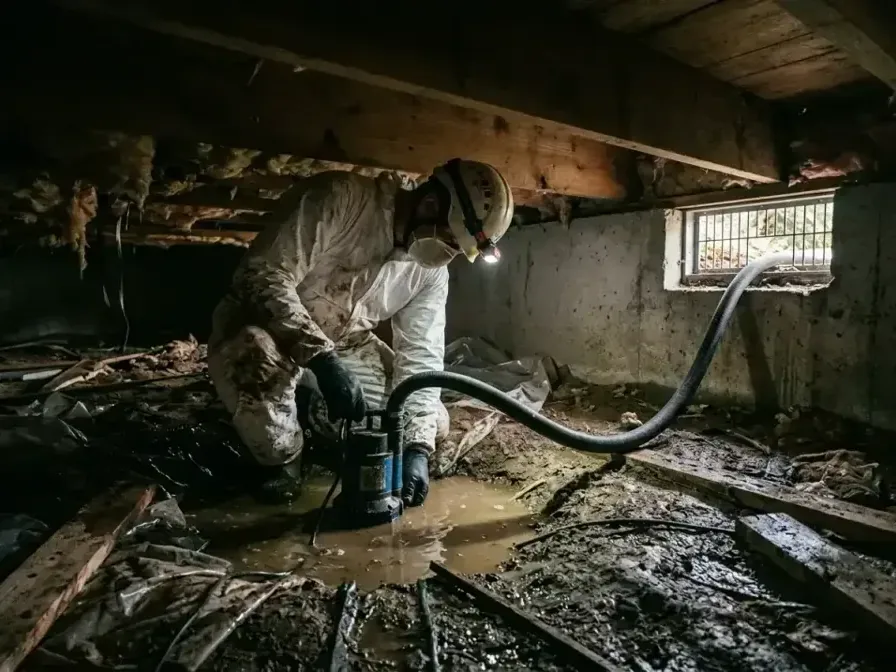
A pump goes at the lowest spot, with hoses that run outside and away from the foundation. The first goal is to move the water out, because every day it sits it soaks deeper into joists and subfloor.
This is the core of crawl space water removal. Slow clay can send water back, so the crew checks the space again to see whether it refills.
Finding the low spot and setting the pump
The crew looks for the deepest part of the crawl space, since that is where water gathers and where a pump works best. Hoses run through the access opening to a spot well away from the house.
Pulling out soaked insulation
Soaked insulation is pulled out in bags, since wet fiberglass holds moisture against the wood above it. That step also lets the framing dry in open air.
Dry insulation that was never touched can stay, and the crew marks where wet gives way to dry as it goes.
- Sagging batts are removed first because they trap water against the subfloor.
- Debris and standing puddles are cleared so the pump does not clog.
- Photos are taken before and after so the change is easy to see.
Drying the framing and subfloor
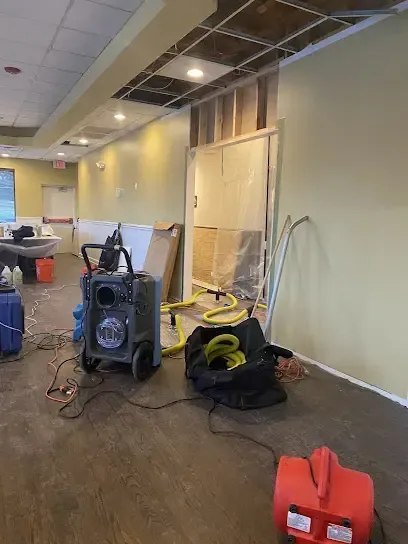
Pumping leaves the wood damp. Readings on joists, beams and subfloor show how much moisture is left, and dehumidifiers and fans are placed to pull it out.
The dry goal is a number, not a feeling. Work ends when framing and subfloor reach it, and that is the point of structural drying.
Equipment stays in place between visits. Each return trip brings new readings, and the fans and dehumidifier are moved to wherever the numbers are still high.
- Joists and beams get readings at several points along their length.
- Subfloor readings show whether water has risen into the floor above.
- Hardwood, if it sits over the crawl space, is watched for cupping.
What damp air under the floor does to the rooms above
Holly Springs has a humid subtropical climate, with rain in every season and muggy summers. A crawl space that stays damp keeps feeding moisture up into the floor system.
The signs show up in the rooms above, often before anyone looks underneath.
- Floors that feel soft, bouncy or cold in spots.
- Hardwood that cups at the edges or leaves gaps.
- A musty smell that is strongest near the floor.
- Doors that start to stick as the framing takes on moisture.
When the water keeps coming back
A crawl space that refills after every heavy rain has a drainage problem outside the house. The extraction crew removes the water that is already there, but it cannot change where the rain goes.
Fixing the cause belongs to a drainage contractor or a plumber, and the best time to call is while the space is still dry enough to inspect. Quick water extraction after each event keeps repeat water from soaking the wood for days.
- Extend downspouts so they empty well away from the foundation.
- Check that the ground slopes away from the house on every side.
- Ask a pro about a pump or drain if the same spot floods again and again.
Questions
Why does a crawl space collect water in Holly Springs?
The area sits on Piedmont red clay that drains slowly, so heavy rain can sit around a foundation and run toward the lowest spot, which is often under the floor.
How can pooled water be told from damp air?
Pooled water shows up as a shine or wet ground in a flashlight beam, and wet insulation hangs low. Damp air alone gives a musty smell with no visible water.
Is wet insulation always removed?
Insulation that has soaked through or fallen is usually bagged out, because it keeps holding moisture against the wood. Dry sections that were never touched can stay.
Can the water just be left to dry on its own?
Standing water keeps soaking joists and subfloor, and damp wood can grow mold. Pumping and measured drying shorten that window.
What if the water is coming from a pipe?
A leaking supply pipe or drain has to be stopped by a plumber. The crew can then remove the water and dry the framing the pipe soaked.