Structural Drying and Dehumidification in Holly Springs, NC
Surface dry is not dry. The drying team sizes air movers and dehumidifiers to the class of the loss and keeps them running until framing, subfloor and flooring read dry against a dry reference.
(888) 578-4720Floors still wet after a leak? Call now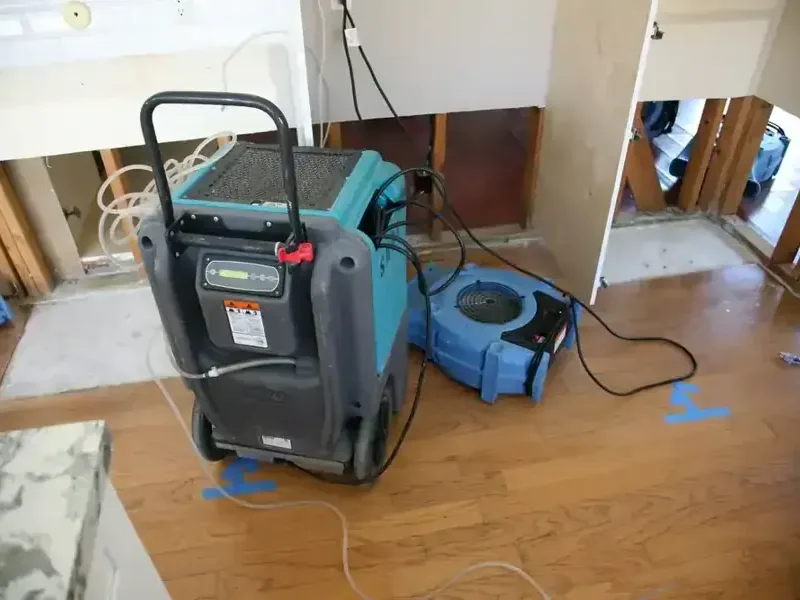
First steps for structural drying
- 1
Keep the HVAC on
Run the air conditioning or heat at a normal setting; it helps the dehumidifiers.
- 2
Leave the equipment running
Do not switch off air movers or dehumidifiers at night; drying stops when they stop.
- 3
Keep doors as set
Leave doors open or closed the way the drying team set them.
- 4
Stay off wet floors
Keep foot traffic off wet hardwood and drying mats.
Trade standards on this job
- Equipment is sized to the class of the loss.
- Readings are logged daily on a psychrometric chart.
- The goal is 2 to 4 points of a dry reference.
What does structural drying cost in Holly Springs, NC?
Structural drying here typically runs $1,500 to $8,000, depending on the class of the loss, the number of rooms, whether hardwood or a slab needs specialty drying and how many days the equipment runs.
One or two rooms, Class 1 to 2
$1,500 to $3,000- Air movers and LGR
- Daily logs
- Three to five days
Whole floor or Class 3
$3,000 to $5,500- More equipment
- Wall cavity drying
- Containment
Hardwood or Class 4
$5,500 to $8,000+- Floor drying mats
- Desiccant dehumidifiers
- Extended monitoring
Ranges are typical, not a quote: the water category, the square footage, the materials and how fast drying started move the number most. Try the water damage cost calculator for a closer planning range.
How structural drying is handled, start to finish
Measure first, remove the water, dry, then prove it dry with readings. The order does not change.
(888) 578-4720Book the dehumidifiers now- 1
Map and classify
Moisture mapping sets the class of the loss and the drying plan.
- 2
Set equipment
Air movers and dehumidifiers are placed to each room's evaporation load.
- 3
Monitor daily
Readings are logged and equipment moved as rooms dry.
- 4
Reach the goal
Materials match a dry reference before the equipment comes out.
Drying is where a water job is won or lost. Water that soaked into framing, subfloor and hardwood does not leave when the floor looks dry; it leaves when the air around it is dry enough and moving fast enough to pull it out. Humid Carolina air makes that harder, which is why dehumidifier sizing matters here.
Class sets the equipment
The IICRC S500 sorts losses into Class 1 to 4 by how much water was absorbed and how hard the materials are to dry. A Class 1 loss in one room needs a few air movers and a dehumidifier. Class 4 materials, such as hardwood, plaster and concrete, hold water deep inside and need desiccant dehumidifiers, drying mats or more time.
- Air movers placed by the evaporation load of each room
- LGR dehumidifiers for most homes; desiccants for dense materials and cool spaces
- Wall cavity and under-cabinet drying through small access holes
- Floor drying mats for hardwood that is worth saving
Readings, not guesses
The drying team records temperature, humidity and moisture readings every day in a psychrometric log, and moves or adds equipment when a room stops improving. The goal is reached when wet materials read within 2 to 4 points of a dry reference material in the same house. That log goes into the insurance file.
Hardwood, crawl spaces and slabs
Site-finished hardwood can often be saved if drying starts before it cups badly. When the water is under the floor, the subfloor is dried from the crawl space at the same time. Slab floors give up water slowly, so the team checks them with meters before new flooring goes down. For a time estimate, try the drying time estimator.
The EPA's indoor air quality page explains why indoor humidity should stay under control, and Ready.gov covers safe re-entry after a flood.
Structural drying across Holly Springs and nearby
The restoration team covers ZIP 27540 end to end: downtown and Main Street, Sunset Ridge, 12 Oaks, Holly Glen, Woodcreek, Arbor Creek and the homes along Avent Ferry Road, Sunset Lake Road and the NC 55 Bypass.
Nearby coverage reaches Apex, Fuquay-Varina, Cary, New Hill, Willow Spring, Garner, Morrisville.
Structural Drying and Dehumidification: common questions
How long does structural drying take?
Most homes dry in three to five days. Hardwood, plaster, concrete and two wet floors can take a week or longer.
Why is the equipment so loud?
Air movers push large volumes of air across wet surfaces to speed evaporation. The noise ends when the readings say dry.
Can I turn the equipment off at night?
It is best not to. Drying stops when the equipment stops, and the job runs longer.
Can hardwood floors be saved?
Often, when drying starts quickly. Floor drying mats and dehumidifiers can bring cupped boards back, though badly warped boards may need replacing.
What is a dry reference?
A reading taken on the same kind of material in a part of the house the water never reached. Wet materials are dry when they match it within 2 to 4 points.
What does drying cost per day?
It depends on the equipment count. More rooms and Class 4 materials need more units and more days.
Still damp after a leak? Get it dried properly.
Water left in framing and subfloor keeps working long after the floor looks dry. The drying team runs the equipment until the readings say dry, 24/7.