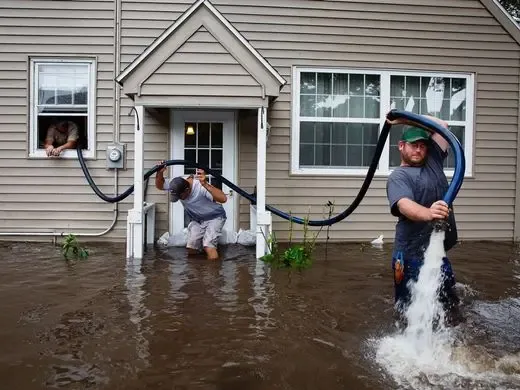
Late summer and fall bring tropical storms and hurricane remnants to Holly Springs, and the first place water shows up is usually the garage door, a back door threshold or a low patio entry. Water that comes in from outside is flood water, and it is handled very differently from a leak inside the house.
Key takeaways
- Water that enters from outside is Category 3 flood water, so porous materials it touched are usually removed rather than dried.
- Garage doors, thresholds and low entries are the common entry points after tropical rain.
- Standing water near outlets, panels or appliances is a reason to stay out until the power is off.
- Hard surfaces and framing are cleaned and dried, while carpet, pad and low drywall are commonly cut out.
- Storm season runs into fall, so a storm water cleanup is a seasonal call here, not a rare one.
How tropical storm water reaches a Holly Springs house
Tropical rain falls in bursts that drains and gutters cannot always keep up with. When the yard fills, water looks for the lowest, softest way into the house.
Gutters packed with leaves, downspouts that empty at the foundation and a yard that slopes toward the house all send water to the door faster. A strong gust can also push rain sideways under a covered entry.
In 1996, Hurricane Fran flooded and damaged much of Wake County, and the remnants of later storms keep the same pattern alive: heavy rain over a short stretch of days.
- The bottom seal of a garage door.
- The threshold of a back or side door.
- A sliding door track packed with leaves and grit.
- The low edge where an attached garage slab meets the house wall.
Why flood water is treated as Category 3
Water that crosses a yard picks up what is in it. That makes storm water grossly contaminated, and the restoration industry calls it Category 3.
Industry practice sorts water into three categories. Category 1 comes from a clean source, such as a supply pipe, and Category 2 is used or gray water.
Category 3 is the most contaminated, and it covers flood water from outside. After a flood the question is not only how to dry a floor but what the water carried into it.
- Soil, mulch and yard runoff.
- Overflow from drains or a sewage system pushed past its limit.
- Fuel, fertilizer and chemicals stored in the garage.
- Bacteria that cling to carpet, pad and the bottom of drywall.
The first day after the water arrives
The first day is mostly about safety and keeping a record. Standing water and live electricity do not mix, and the damage grows while the water sits.
Calling for storm and flood water cleanup as soon as it is safe starts the removal work and gets drying equipment going before materials soak through.
- Stay out of any room where water is above the outlets until the power is off.
- Photograph the high water mark on walls, doors and stored items.
- Do not wade through standing water to reach a panel or an appliance.
- Move valuables to dry, high ground, and leave heavy furniture where it stands.
- Keep children and pets out of rooms that took on storm water.
The cleanup order: what is removed, cleaned and dried
Flood water changes the plan for every material it touches. The rule of thumb is simple: hard, sealed surfaces can be cleaned, and soft, porous ones usually go.
Work also follows a set order. Water comes out first, wet materials come out second, and cleaning and drying follow once the space is stripped to what can be saved.
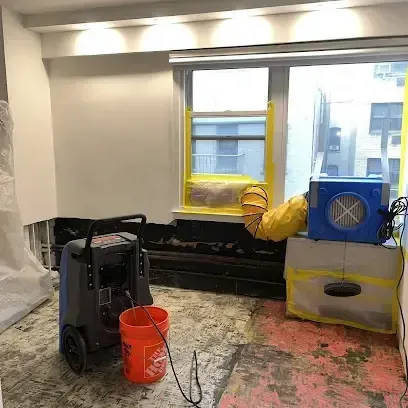
Drying follows removal, and structural drying keeps going until readings on framing and concrete reach the dry goal.
- Pump or extract the standing water from the garage and any rooms it reached.
- Remove carpet, pad and the lower section of wet drywall.
- Clean slabs, framing and hard surfaces so the contamination is not left behind.
- Set fans and dehumidifiers and take readings on framing and concrete.
- Check the walls again before anything is rebuilt, so moisture is not sealed in.
Usually removed
- Carpet and pad that sat in the water.
- Drywall and insulation that wicked water up the wall.
- Baseboards and soft trim that swelled.
- Boxes, rugs and stored cloth items from the garage floor.
Usually cleaned and dried
- Concrete slabs and sealed tile.
- Wall studs, plates and joists.
- Hard cabinets and solid wood furniture, when they are not warped.
The attached garage and the rooms behind it
A garage slab is the first stop for door water. From there, water crosses the threshold of the door into the house or runs along the slab edge into a wall.
Water heaters and other mechanical gear are often found in garages here, which is one more reason to keep out until the power is off. A water extraction crew pulls the standing water first, then the team maps where it went.
What the team checks along the garage wall decides whether the job stays in the garage or moves into the rooms behind it.
- The wall shared between the garage and the house, checked at its base for wet drywall.
- The door from the garage into the house, including its threshold and trim.
- Any water heater, furnace or air handler stand that sits on the garage floor.
- Stored boxes and shelving that wicked water up from the slab.
Records that help after a storm
A storm can leave a house in a hurry, and the details fade fast. A few photos and notes taken early keep the story straight for everyone who works on the house afterward.
That includes the cleanup team, a plumber, an electrician and anyone who handles repairs.
- Take wide photos of each room, then close photos of the high water mark and wet materials.
- Write down when the water came in and where it entered.
- List stored items that were on the floor and what shape they are in.
- Keep removed materials out of the way until they have been photographed.
Local water and a storm season that runs long
Middle Creek, Utley Creek, Bass Lake and Sunset Lake shape the local landscape, and Harris Lake lies to the west. Heavy rain can raise water on any side of a house, not just near a creek.
Because the season stretches from late summer into fall, storm water cleanup is a recurring call. A drying time estimator gives a rough picture of how long a wet house can take once the water is out.
Questions
What makes storm water Category 3?
Water from outside carries soil, bacteria and chemicals, so it is grossly contaminated. That label shapes what gets removed and how surfaces are cleaned.
Can carpet be saved after flood water?
Carpet and pad that sat in Category 3 water are usually removed. The slab or subfloor under them is cleaned and dried.
Is a wet garage slab fine to leave alone?
A slab holds moisture and can pass it into the wall bottoms beside it. The slab is cleaned and dried, and the walls next to it get checked.
Why do tropical storms matter late in the year?
Tropical storms and hurricane remnants reach the area in late summer and fall, so heavy rain events can still arrive after the summer thunderstorms are over.
What if the garage door water never reached the house?
Water that stayed in the garage still needs to be pulled out and the slab cleaned. A check along the wall shared with the house shows whether it moved inside.