Crawl Space Water Removal in Morrisville, NC
Water under the floor sits unseen while joists, insulation and the vapor barrier soak it up. The extraction crew pumps the space out, removes wet material and dries the framing above.
(888) 578-4720Call about the crawl space water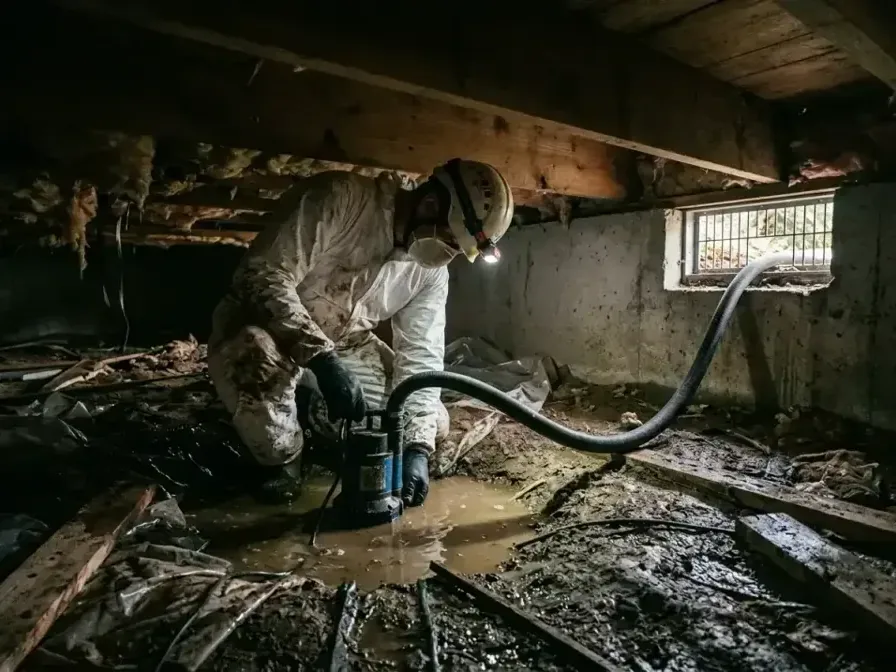
First steps for crawl space water removal
- 1
Stay out of the space
Avoid entering a flooded crawl space, where wiring, slippery soil and contaminated water create hazards.
- 2
Stop the source
If a pipe is leaking, shut the main valve; if runoff is entering, turn downspouts away from the foundation.
- 3
Check the floors
Look for soft or cupped floors and damp odors inside the house, and photograph anything unusual.
- 4
Call for pumping
Phone the restoration team so pumps and drying equipment can be matched to the water in the space.
Trade standards on this job
- Standing water is pumped before anything else is touched.
- Joists and subfloor are metered at every visit.
- Sewer water is handled as contaminated, never as clean water.
What does crawl space water removal cost in Morrisville, NC?
Pumping and drying a crawl space usually costs $1,200 to $2,500. Removing insulation and the vapor barrier runs $2,500 to $4,500, and contaminated or long-standing water can reach $4,500 to $6,500+.
Pumping and drying
$1,200 to $2,500- Standing water pumped
- Dehumidifier running
- Wood read daily
Insulation and barrier removed
$2,500 to $4,500- Wet batts pulled
- Vapor barrier removed
- Joists and subfloor dried
Category 3 or a long soak
$4,500 to $6,500+- Storm or sewer water
- Cleaning and treatment
- Extended drying
Ranges are typical, not a quote: the water category, the square footage, the materials and how fast drying started move the number most. Try the water damage cost calculator for a closer planning range.
How crawl space water removal is handled, start to finish
Measure first, remove the water, dry, then prove it dry with readings. The order does not change.
(888) 578-4720See the pumping steps- 1
Find the source
The crew checks for leaking pipes, runoff paths and drain failures feeding the water.
- 2
Pump it out
Submersible pumps lower the water until the soil is exposed.
- 3
Remove the wet
Soaked batts and a saturated vapor barrier are pulled and bagged.
- 4
Dry the wood
A dehumidifier and air movers run while joists and subfloor are metered.
A crawl space collects water from several directions: a leaking supply pipe above, runoff that soaks in after heavy rain, or sewer water that backs up from a failed drain. Because the space is dark and closed, standing water can sit for days while the wood above absorbs moisture and the floors begin to feel soft.
Water finds low ground
Gently rolling hills that slope east, where the Piedmont meets the Coastal Plain, give water on a lot somewhere to go, and a crawl space is typically the lowest enclosed part of a house. Whether the water arrives through a vent, a wall or a pipe, it is pumped out and the source is identified before drying starts.
- Runoff entering through foundation vents
- A leaking supply pipe or water heater above
- Sewer or drain water from a failed pipe
- Groundwater seeping in after prolonged rain
What gets pumped, pulled and dried
Submersible pumps clear standing water first, and the crew works in protective gear because crawl space water can be contaminated. Wet insulation is pulled from between the joists, and a saturated vapor barrier is removed so the soil and framing can release moisture.
Joists and subfloor are metered, then dried with air movers and a dehumidifier sized for the space. Wood that stays above its dry goal is checked again at every visit.
Crawl space work is also coordinated with plumbers and any foundation or grading contractor, since drying alone does not keep the next storm out.
Contaminated water and records
If the water came from a sewer or drain, it is treated as Category 3: porous materials are removed and exposed wood is cleaned and treated before drying. Sewage backup cleanup covers that case in detail.
Photos and wood readings are kept for the adjuster, and storm and flood cleanup applies when runoff caused the loss.
Crawl space water removal across Morrisville and nearby
Crawl space work covers any home across town that has one, from single-family streets in Breckenridge and Weston Estates to townhome communities such as Town Hall Commons, wherever water has reached the space under the floor.
The same service nearby: crawl space water removal in Holly Springs, Apex, Chapel Hill.
Water damage restoration in Morrisville · every town covered
Crawl Space Water Removal: common questions
Is water in a crawl space always urgent?
Standing water can soak joists and insulation quickly, so it is treated as urgent. Even when the floors above look fine, wood readings often show moisture that is not visible.
Can the vapor barrier be reused?
A barrier that stayed clean and intact may be reused, but one that soaked or was contaminated is removed. It is replaced after the space has dried.
How is a crawl space dried?
Water is pumped out, wet material is removed, and a dehumidifier and air movers dry the joists and subfloor. Daily wood readings show when the framing is back to normal.
Does the water come from a creek or the sewer?
It depends on the source. Runoff, pipes and drains each leave different clues, and sewer water is treated as contaminated. The source is identified before drying begins.
Is it safe to enter a flooded crawl space?
Not without protective gear. Wiring, slippery soil and contaminated water are hazards, so the crew handles the work and homeowners stay out until it is cleared.
Will mold start under the house?
Damp wood and insulation can support mold within a couple of days, which is why the space is dried quickly. Readings confirm the framing has returned to normal before the work is closed.
Water under the floor keeps soaking the wood
Stay out of the flooded space, stop the source if it is safe and call so pumps and drying equipment can be planned.