Structural Drying and Dehumidification in Morrisville, NC
Once the standing water is gone, moisture stays locked in framing, subfloor and drywall. The drying team places air movers and dehumidifiers and tracks readings until the structure matches a dry reference.
(888) 578-4720Call about wet framing and floors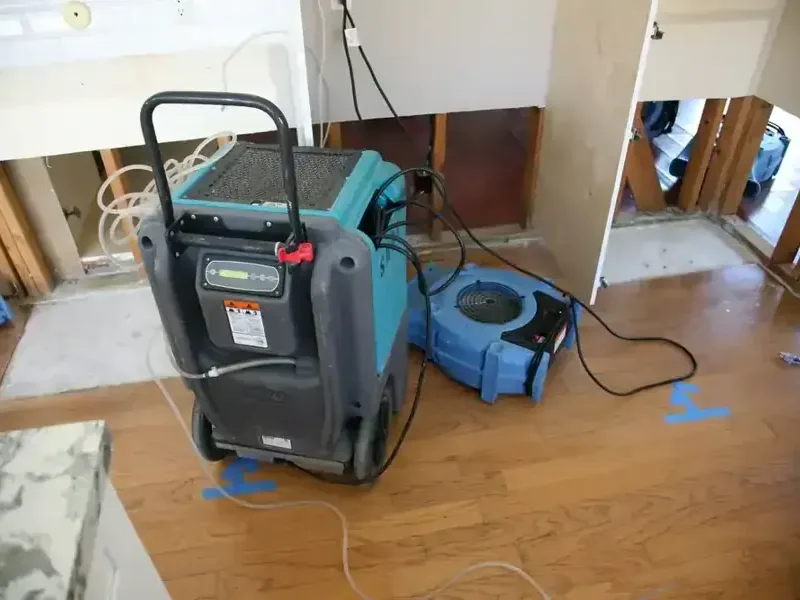
First steps for structural drying
- 1
Keep the doors closed
Keep the affected rooms closed so the equipment works on a controlled space.
- 2
Leave equipment alone
Do not move or switch off the air movers and dehumidifiers.
- 3
Empty what is wet
Take wet books, boxes and cushions out of the room so they do not hold moisture back.
- 4
Allow access for readings
Be available at each visit so the crew can take readings and adjust the equipment.
Trade standards on this job
- Readings are taken from the same spots every visit.
- Equipment is moved or added as the numbers change.
- Nothing is removed until it matches a dry reference.
What does structural drying cost in Morrisville, NC?
One or two rooms usually cost $1,500 to $3,000 to dry. A whole floor or Class 3 loss runs $3,000 to $5,500, and hardwood or Class 4 drying with desiccant units can reach $5,500 to $8,000+.
One or two rooms, Class 1 to 2
$1,500 to $3,000- Air movers and LGR units
- Daily log entries
- Several days of drying
A whole floor or Class 3
$3,000 to $5,500- Added equipment
- Wall cavity drying
- Containment set
Hardwood or Class 4
$5,500 to $8,000+- Drying mats on the floor
- Desiccant dehumidifiers
- Monitoring continues
Ranges are typical, not a quote: the water category, the square footage, the materials and how fast drying started move the number most. Try the water damage cost calculator for a closer planning range.
How structural drying is handled, start to finish
Measure first, remove the water, dry, then prove it dry with readings. The order does not change.
(888) 578-4720See the drying steps- 1
Measure and class
Readings place the loss in a drying class and set the equipment plan.
- 2
Place the equipment
Air movers and dehumidifiers go in by room, aimed at wet surfaces.
- 3
Read and adjust
Each visit adds readings, and units are moved or added as numbers fall.
- 4
Confirm and remove
Equipment leaves once every material matches its dry reference.
Structural drying is the slow part of a water job and the part that protects the home from hidden damage. Water that has soaked into wood and drywall does not leave on its own, so the drying team creates conditions that pull it out, and measures until it has gone.
How wet materials dry
Air movers push dry air across surfaces and wall cavities so moisture evaporates, and dehumidifiers remove that moisture from the air so it cannot settle somewhere else. Low-grain refrigerant units suit most rooms, while desiccant units help in cool spaces or with dense materials.
- Air movers set along floors and wall bottoms
- LGR dehumidifiers matched to the room volume
- Floor drying mats for hardwood and tile
- Cavity drying through small openings in the wall
Classes of water loss
Drying classes describe how much moisture the materials absorbed. A Class 1 or 2 job involves a small area or porous materials, Class 3 means water came from above and soaked walls and ceilings, and Class 4 involves dense materials like hardwood and concrete that release moisture slowly.
A class is set at the first visit and revisited if the readings surprise the crew.
Readings, adjustments and the finish
At every visit the crew takes readings from the same spots, then moves or adds equipment based on what dropped and what did not. Equipment comes out only when framing, subfloor and drywall match the dry reference for that material.
The log of dates, readings and equipment is the record the adjuster sees. Drying often follows water extraction and burst pipe water damage calls.
Structural drying across Morrisville and nearby
Drying equipment runs in single-family homes such as those in Breckenridge and Weston Estates, townhomes and condos in Town Hall Commons and Carpenter Park, apartments at The Slater and commercial suites near McCrimmon Corners.
The same service nearby: structural drying and dehumidification in Holly Springs, Apex, Chapel Hill.
Water damage restoration in Morrisville · every town covered
Structural Drying and Dehumidification: common questions
How long does structural drying take?
Most small losses dry in several days, while hardwood, thick framing and long soaks take longer. Readings decide when the equipment leaves.
Why are the dehumidifiers so loud and warm?
They pull moisture from the air and release dry, warmer air, which is how the structure dries.
Can fans alone dry a wet floor?
Fans move air but do not remove moisture from it, so humidity climbs and drying stalls. Dehumidifiers keep the air dry enough to draw water out of wood.
Does hardwood have to be replaced?
Not always. Floor drying mats and desiccant units can save boards caught early, while cupped or buckled sections may need replacement once readings are in.
How does the crew know the structure is dry?
Final readings are compared with a dry reference taken from unaffected material of the same type. The equipment is removed only when the wet areas match it.
Will drying run up the electric bill?
Equipment does draw power for several days, so a short rise in the bill is normal. The equipment log shows how long each unit ran.
Dry readings are what end a water loss
Keep the rooms closed and the equipment running, and call to plan a drying schedule matched to the materials that got wet.